
An Impossible Job
On scope creep, sustainability, and new models for ministry

Outside of the world of religious institutions, most people don’t know (and possibly don’t care, but that’s a post for a different time), but the vocation of ministry has quietly become an impossible job.
It wasn’t that long ago that ministers were primarily responsible for preaching and pastoral care. Now congregations often expect one person, the minister, to handle leadership development, organizational systems, faith formation, administration, staff supervision, social justice coordination, governance, strategic planning, technology, building issues/emergencies, and communications. Oh, and still preach good, unique, fresh, relevant sermons nearly every week.
That scope doesn’t fit very well into a full-time job1 on a good day, but today, with the pressure of what is happening in the country around us, it is becoming more and more impossible. And imagine trying to squeeze this into a part-time job!
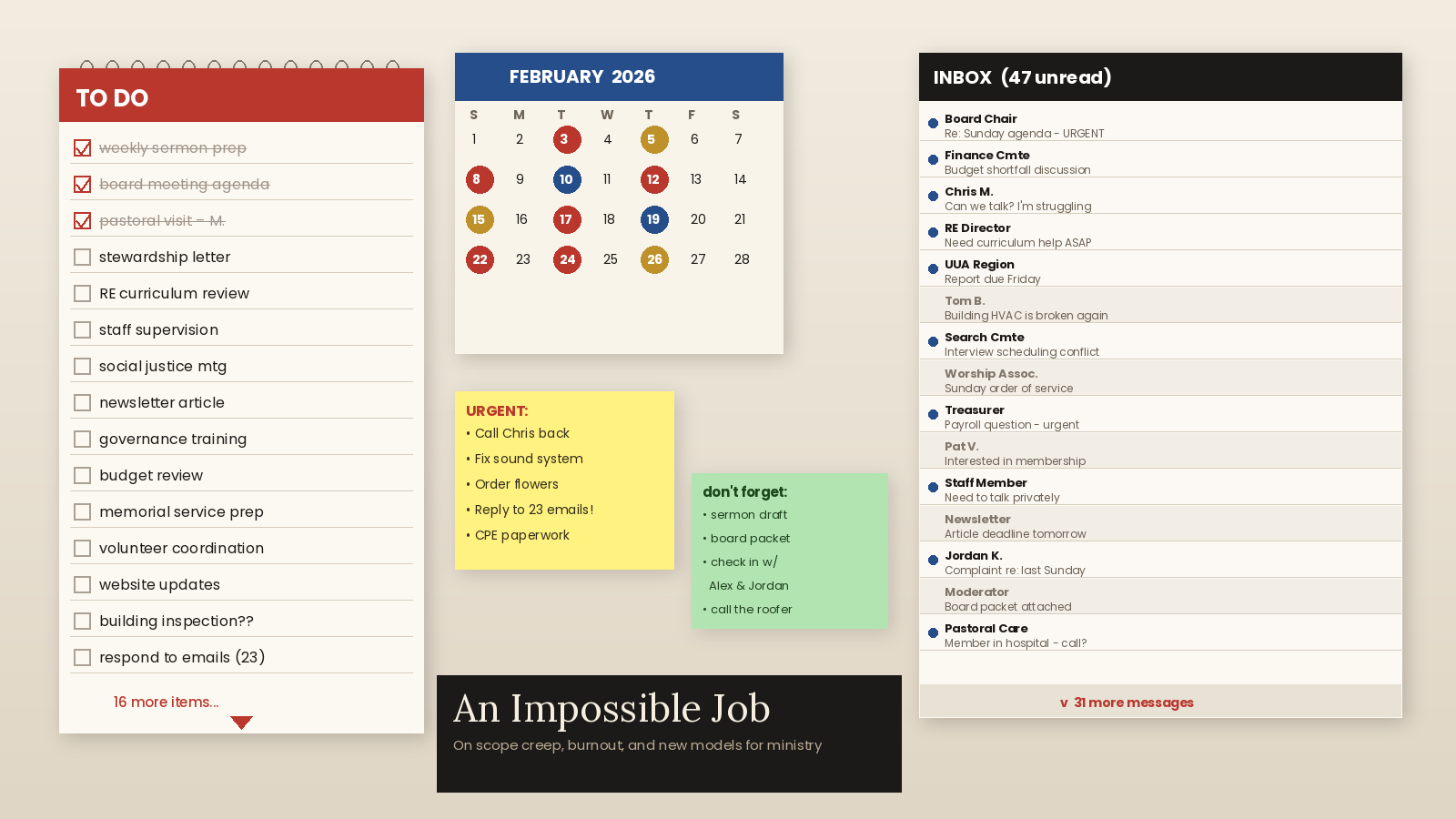
Meanwhile, as the scope of ministry continues to creep, fewer and fewer congregations can afford full-time ministry. Attendance is down. Giving patterns are down. Church membership populations are aging. Many communities that once supported a full-time minister (or even multiple!) are discovering their resources - and their needs - look very different now. And on top of that, volunteerism is changing; people don’t have as much spare time to do the work of the church, so more gets outsourced to staff, which puts additional pressure on both the budget and the minister.
When it comes to part-time ministry, what usually happens is a congregation hires a minister and then expects everything, or nearly everything, anyway. In a few short years, the minister burns out or moves on. The congregation feels let down. Trust thins. Momentum stalls. Everyone is frustrated and nobody is quite sure why. Wash, rinse, repeat.
I’ve been sitting with this problem for a while. And I think there’s a better way.
What if part-time ministry didn’t mean trying to do a full-time job at part-time pay? What if instead, a minister and congregation chose one or two areas where concentrated work together could make a real difference - and went deep together on that?
Maybe you would collaboratively choose governance. Or worship development. Pastoral care systems. Leadership cultivation. Strategic planning. Pick what matters most right now, do that work together with real intention, and trust that the ripple effects reach everything else.
This model assumes something different about ministry - it assumes the minister is not the hub through which everything flows. It assumes congregations can be empowered, leadership can be cultivated, and that systems can be strengthened.
And this does not necessarily require the minister and the congregation to even live near each other. This is particularly important because since the pandemic, ministers are less likely to geographically relocate to a place that they don’t already have family or a community. But the pandemic also taught us that we can do a lot of really great stuff together via technology.
In the model I'm building, the minister would be with the congregation for a couple of intensive in-person residencies - two to four weeks long - once or twice a year. These residencies would be up to double the usual amount of time (i.e. up to full time for a half-time ministry) and would focus on relationship building, preaching in person, meeting with leadership, facilitating retreats, training teams, and pastoral care. And in between these residencies would be a robust remote ministry.
This isn’t a circuit rider or pulpit supply model, nor is it a contract version of traditional settled ministry. It’s a partnership model that is focused, relational, and, hopefully, sustainable for everyone involved.

I’m not alone in thinking about new approaches to this crisis - many of my colleagues are trying out different models for creative partnerships and hybrid ministry. What excites me about this larger picture is that there does not need to be a one-size-fits-all solution. Some of my colleagues using similar models fly out to be with their congregations once a month for intensive weekends. That won’t work for me and my audacious plan. So instead, I’m imagining intensive in-person residencies (longer stretches together, real immersion) followed by thoughtful, sustained work from a distance. My model is built more around depth than frequency.
None of these models will be right for every community - and they will all require strong lay leadership, a willingness to embrace shared ministry, and an honest reckoning with what a congregation actually needs versus what it’s always expected. It will also likely mean congregations have a conversation about what they can give up so that they can do the rest better.
But I believe there are congregations out there - smaller, scrappy, deeply committed to their mission - who are ready to try something new. And I believe there are a lot of ministers who are hungry for a way to do this work without burning out who are looking for a new way.
The sustainability crisis in ministry is real, and it deserves more than hand-wringing. It deserves people willing to experiment, to imagine impossible things. My colleagues are already experimenting. I’m experimenting. None of us have it figured out yet but that feels less like a problem and more like an invitation.
After all, it’s not even breakfast yet.2
Someday, perhaps, I will write something more about why this happened, but I think a lot of it comes down to the feminization of the industry (in this case, ministry), which is what happens when the proportion of women in a specific sector or occupation increases: wages drop, status drops, etc. And in ministry, what I think we are seeing is that to justify the professional wages and to try to maintain status, ministers have taken on more and more. This isn’t too different from what is happening with nursing, where nurses have taken on many tasks that were historically handled exclusively by doctors.
“Alice laughed. ‘There’s no use trying,’ she said. ‘One can’t believe impossible things.’
‘I daresay you haven’t had much practice,’ said the Queen. ‘When I was your age, I always did it for half-an-hour a day. Why, sometimes I’ve believed as many as six impossible things before breakfast.” Lewis Carroll, “Alice Through the Looking-Glass”