
Carrying Water
How I Stopped Touring Sacred Spaces and Started Experiencing Them

The first time I walked into La Sagrada Família, in 2010, I was a tired mom with two small kids, barely keeping it together. I don’t remember a tour. I don’t remember the crowd. I remember awe. I remember being completely unable to find the words.
So when I went back this spring, sixteen years later, I expected that awe again. This time we were able to have the full Sagrada Familia experience: the interior is mostly complete, the towers were accessible. We had the tour guide, the headphones, the works. I walked in ready.
And I felt... interested. Impressed. Informed.
But not transformed.
The guided tour gave me information about the cathedral. I realized I was consuming La Sagrada Família the way I consume a documentary or a well-written article — appreciating it, learning from it, keeping my distance. It was amazing, don’t get me wrong. I don’t think you can visit La Sagrada Família without a sense of your mind being blown. But that…wasn’t what I had been hoping for.
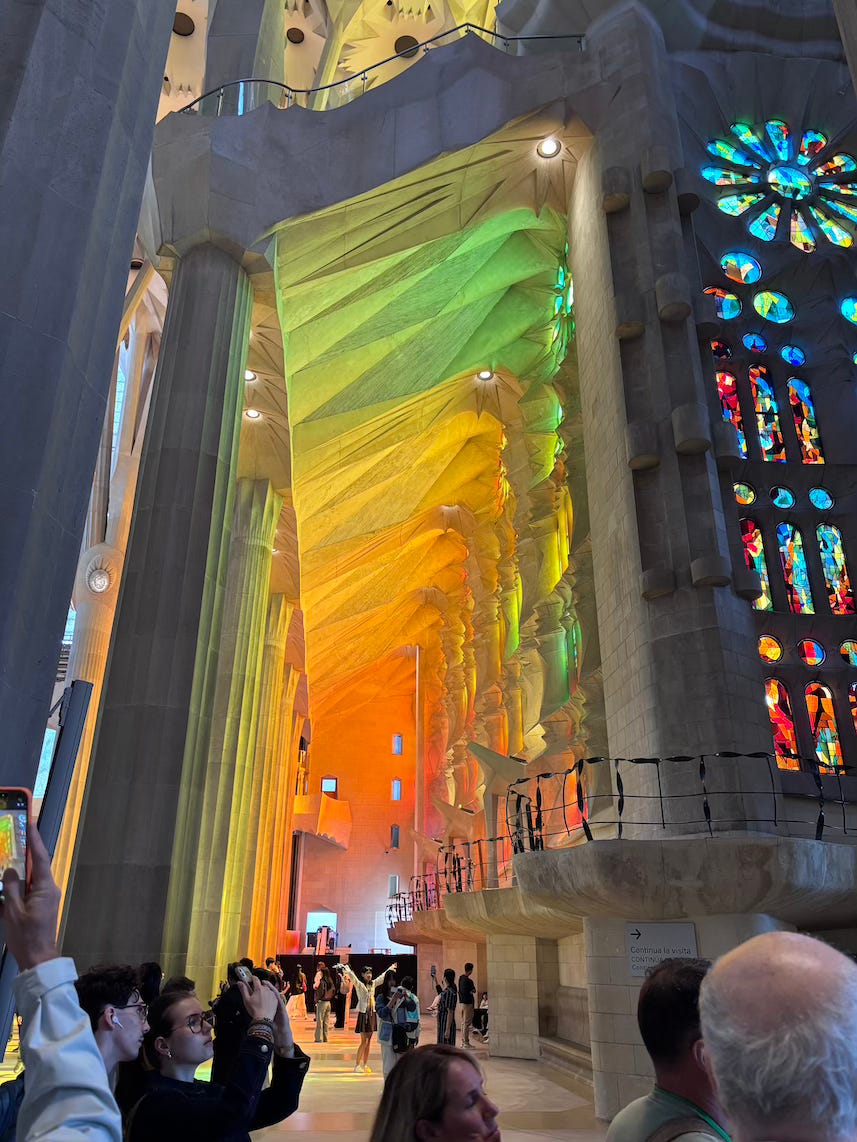
Then my friend noticed that the St. Joseph’s chapel was sectioned off for silence and prayer. She asked if we could go in. We did. I sat in the back row at first, then moved up three rows to the front. It was a small chapel, not a big space, and I wanted to be bathed in the colored light streaming through the stained glass. I prayed silently: For peace, for our world, for wisdom and compassion and courage from our leaders. I cried. And I let the light fill me with hope. And that was just what my heart and spirit needed.
Same building. Same afternoon. Two completely different relationships with the sacred.
One of my favorite classes in seminary was church architecture. It fascinated me because theology becomes physical in the use of light, scale, orientation, sound. To truly appreciate sacred architecture is to understand a community’s (or an architect’s understanding of the community’s) deepest beliefs etched in stone and glass and wood.
The theologian Henry Nelson Wieman wrote about the divine as a creative process. He understood “God” as creativity itself, working in and through human experience. He believed we experience the divine when we encounter something that increases our capacity to appreciate, to feel, to connect. Standing in La Sagrada Família with my mouth open, overwhelmed by what human beings had imagined and built, the awe I felt – in Wieman’s understanding that very much was an encounter with the sacred.
But. And. For me, I realized that this sort of awe and appreciation feels very different than when I am able to experience the purpose of the thing.
Marge Piercy wrote a poem called To Be of Use: “Greek amphoras for wine or oil, Hopi vases that held corn, are put in museums but you know they were made to be used.” They cry out for the work they were built to do.
That’s what happened to me in La Sagrada Família. The guided tour showed me the beautiful pitcher behind glass. The experience in the chapel let me carry water.
This shift from appreciating to participating changed how I experienced every sacred space for the rest of my accidental pilgrimage. Not because I decided it should but just because once I’d felt the difference, I couldn’t unfeel it.
My friends had planted a seed early on that I didn’t notice at the time. They’d recently moved to Spain and mentioned that when they visit cathedrals in other cities, they try to attend a worship service rather than just tour the building. Go to evensong. Sit through mass. Be present while the space is being used for what it was built for. At the time I thought: nice idea. By the end of the trip, I didn’t just understand what they meant, I craved it.
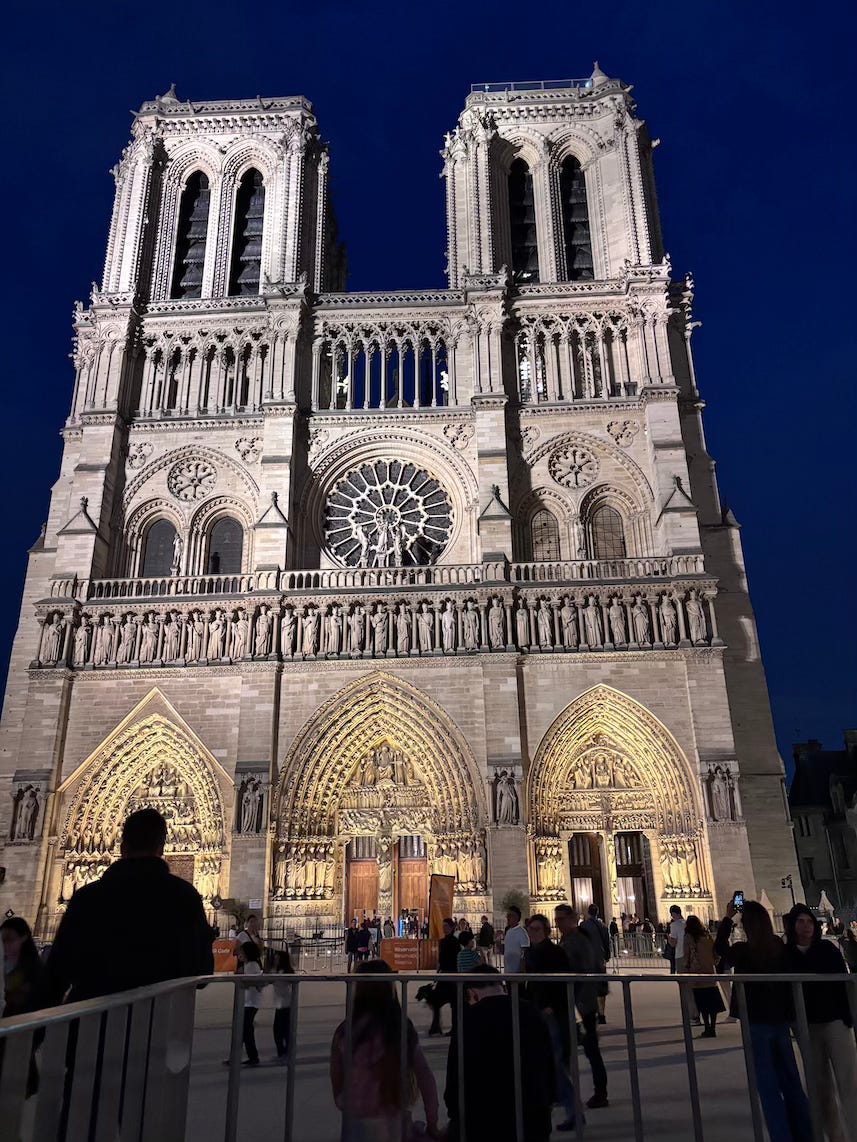
In Paris, I stood outside Notre Dame and didn’t go in. The line was too long, and we had a train to catch. But I also realized I didn’t need to go in. Not every cathedral needed to be entered and catalogued. Sometimes looking up and saying “that looks important” (which is literally what I said! I didn’t even recognize it at first!) was sufficient. I wasn’t participating. I wasn’t even really appreciating. I was just acknowledging. And for that day, that was enough.
But there was a church in Paris that I went into. By the time we got to Montmartre, I was starting to feel overwhelmed. And with the crowds there, shopping at the outdoor market for tourists, I tipped over into overstimulated. I needed a break. I needed some space and quiet to get my emotional regulation in hand. And there, nearly next door to Sacré-Cœur (which every tourist was pouring into and had a line stretched around the block), I noticed a small, quiet church that most people were walking right past. We ducked into Saint-Pierre de Montmartre.
It turns out Saint-Pierre is one of the oldest surviving churches in Paris, sitting quietly in the shadow of its more famous neighbor. Nearly nine hundred years of people coming in weary, grieving, searching, praying.
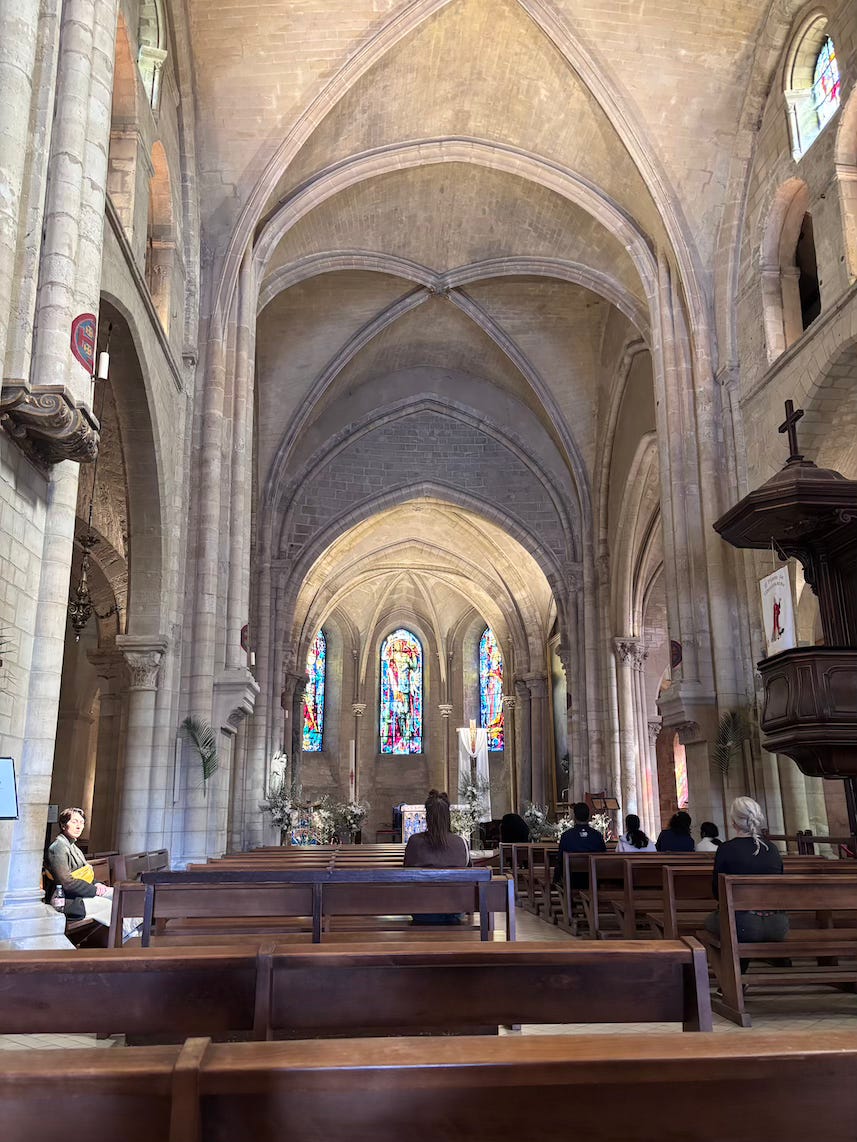
There was quiet music playing, inviting us to rest. I just sat in the back and let the peace settle over me. I wasn’t appreciating. I wasn’t even consciously participating. I was just... taking shelter. Letting a space that had been holding people for nine centuries hold me for a few minutes.
And it did. It worked. I walked out regulated, calmer, able to keep going. The space didn’t care why I came in. It just did what it was built to do.
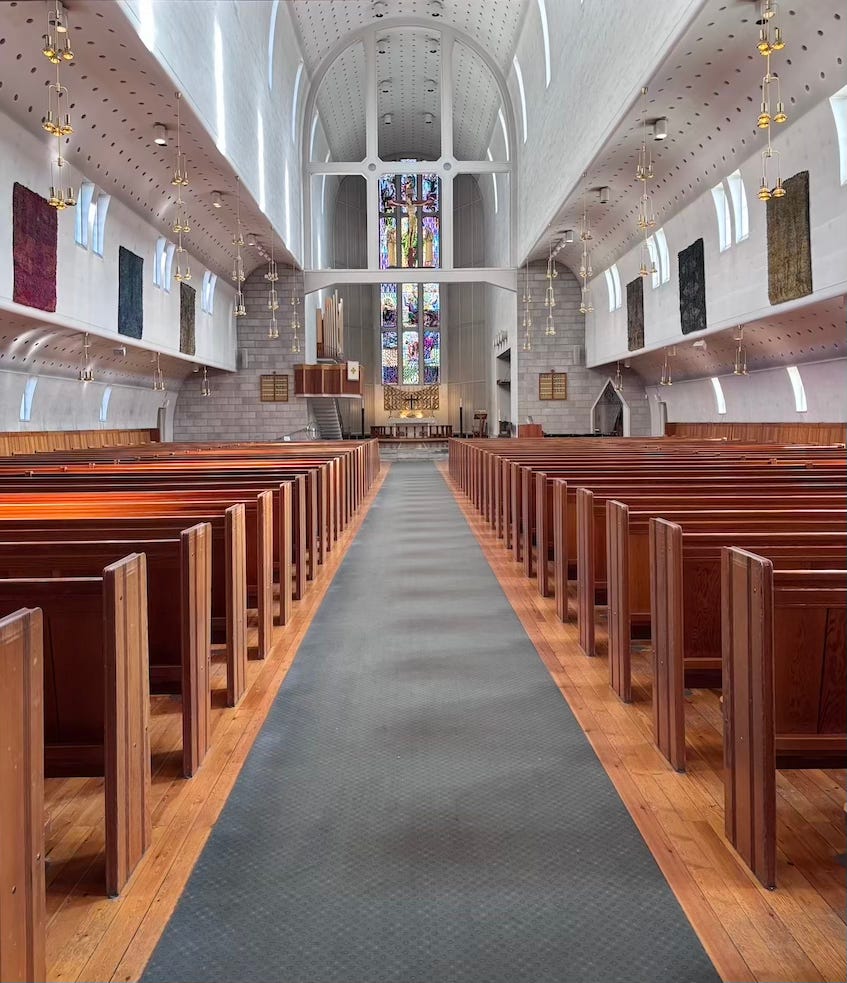
After Paris, I went to Bodø, Norway. Above the Arctic Circle, I sat in a cathedral that had been completely rebuilt after the original burned in a 1940 bombing. A 12-metre stained glass window with a distinctly brown Jesus. Ten tapestries from Nordland. A chapel dedicated to Saint Olav. It was quiet and I was completely alone. I sat there and thought about what it means to worship in a space that exists because people chose to rebuild something beautiful where something beautiful had been destroyed. I wasn’t just appreciating the architecture. I was sitting inside a community’s decision to not let destruction have the last word. That felt like participation, even in the silence.
And then there was Nidaros. I arrived at Nidaros Cathedral in Trondheim expecting the kind of reverent quiet I’d found in Bodø, though I knew there would be more crowds. Instead, I walked into a kindergarten service.
Children everywhere. Some sitting, some absolutely not sitting. One in a full meltdown. A children’s choir. A juggler. A woman in a white robe with a collar and stole leading the whole glorious, chaotic thing.
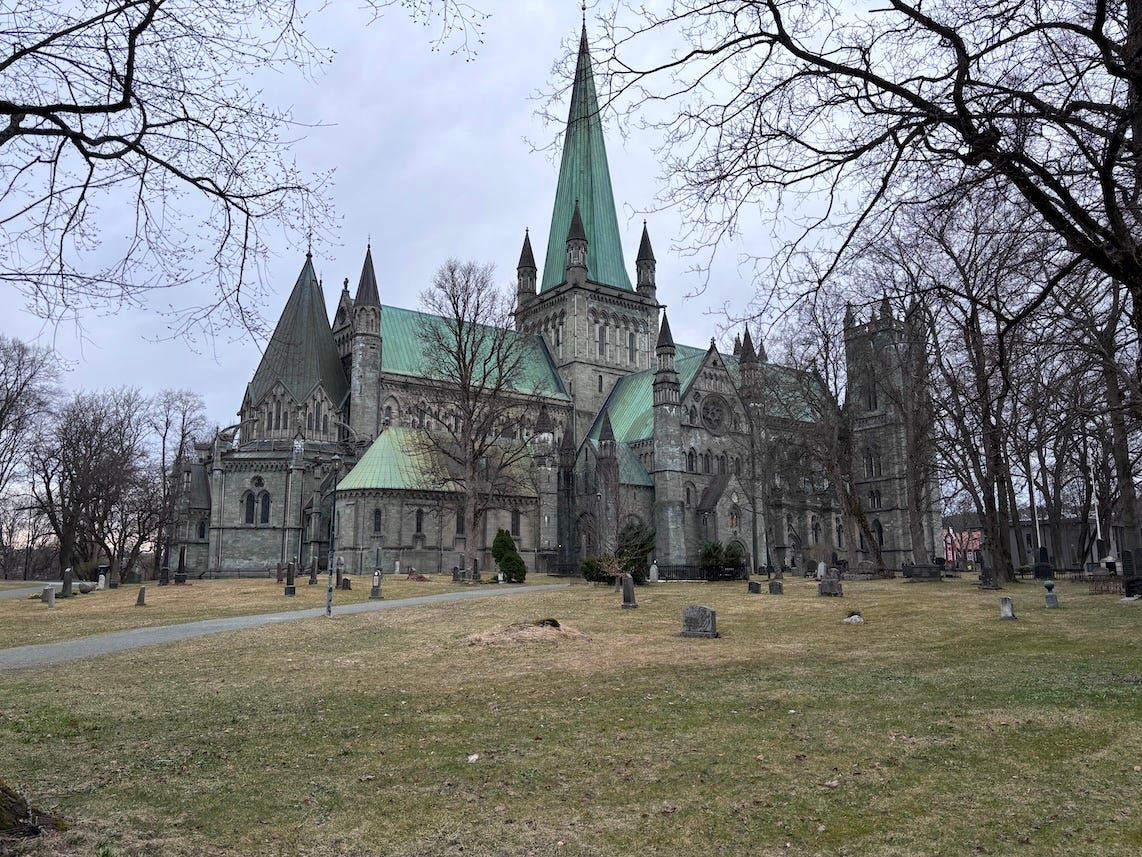
This cathedral, which is the northernmost medieval cathedral in the world, was built over the grave of a saint, burned and rebuilt six times over a thousand years. And it wasn’t just being appreciated (though most of us were doing that, too), it was in the midst of being used for exactly what it had been built for. And the distinction between those two things hit me so hard I had to sit down.
After the service, I spoke with the priest, Chaplain Marie Farstad. I told her I was a minister, and I knew how hard it was to lead worship for kids that age. We laughed about it. I told her how powerful it was to see a woman leading in a cathedral. And I cried, because it still surprises me when I encounter that, even though it shouldn’t anymore. Even though I’ve been in ministry for over twenty years. She was gracious about it. She just let me have the moment.
Later, Bishop Herborg Finnset showed me the octagon, which is the oldest part of the cathedral, built over St. Olav’s grave. She pointed out the carved stone roses that go from bud to full bloom as you move through the space. Flowers of paradise, she said. Blooming in stone for eight hundred years.
She told me that when they were rebuilding the west front of the cathedral, they didn’t know if they could figure out how the rose window had been constructed. The plans were incomplete. But as they kept working, the way revealed itself.
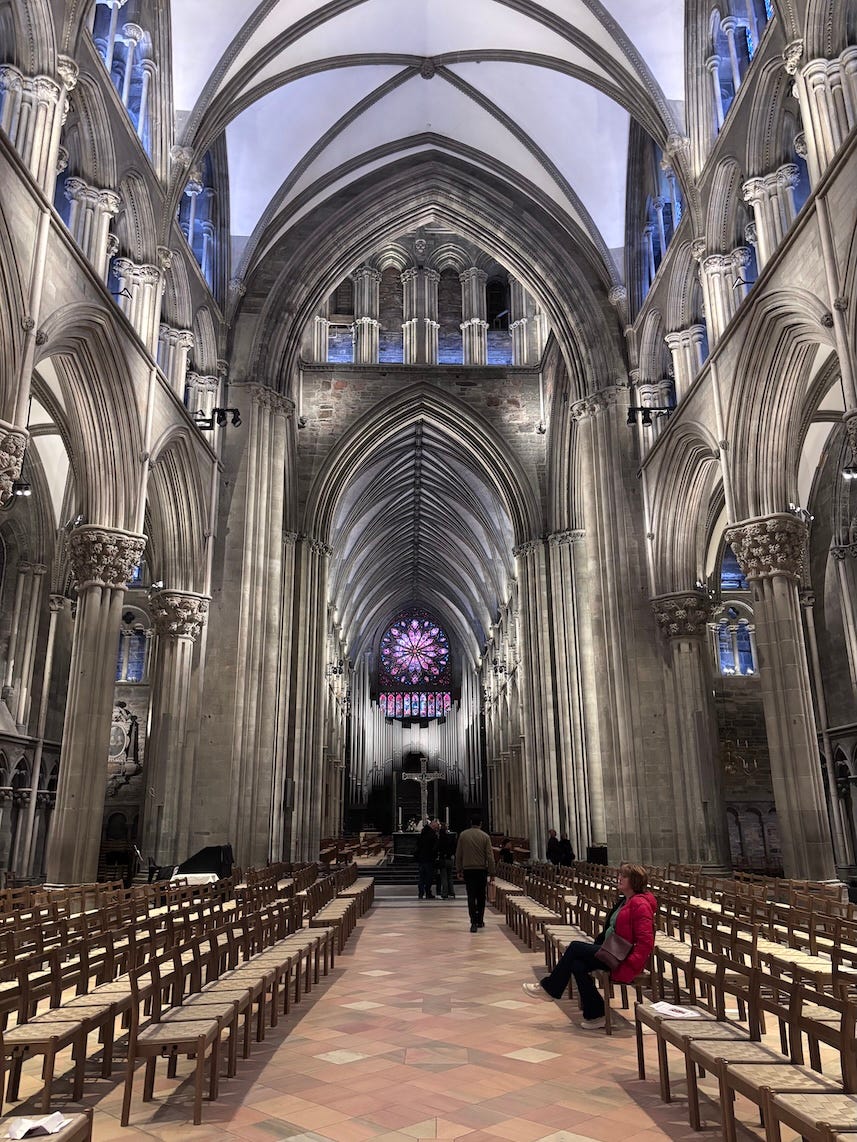
The way revealed itself. I keep turning that phrase over and over. It’s what happens when you commit to the work before you fully know the outcome. Ministry feels like that to me. Parenting too. And, apparently, pilgrimage.
And then Bishop Herborg told me about the Church of Norway’s understanding of itself — not just as a religious institution but as a civil one, with both Christian and humanistic responsibilities. Not just saving souls in some future life, but caring for people in this one. Showing up for the whole society, not just the 60% of Norwegians who belong to the Church of Norway.
I’ve been preaching something like that for a long time, and hearing it described so casually, so matter-of-factly, by a woman bishop in a thousand-year-old cathedral was life giving. Awe-inspiring. Transformative.
Five churches. Five different relationships with sacred space. I don’t think any of these experiences was wrong or wasted. For me, the experience became transformative when I could both understand the history of a space and participate in what it was built for. When I could see the pitcher not just behind glass, but carrying water. When I could be inside the space not just as a visitor, but as a participant in what it was built for.
This is something to keep in mind in my upcoming travels: I want both. I want the background AND the experience. The history AND the living practice. The information AND the transformation.
I didn’t plan any of this. I packed for a punk concert, but somewhere between a chapel in Barcelona and a kindergarten service in Trondheim, I stopped being a tourist and started being a pilgrim. Not because I decided to, but because the way revealed itself.