
Someone Always Pays
What corporations don't pay, the rest of us do

As a part of my MPA program, I took an economics class. I was in the online program at Indiana University’s School of Public and Environmental Affairs (now the Paul H. O’Neill School of Public and Environmental Affairs). Let me geek out just for a bit: this is the same program where Elinor Ostrom won a Nobel Prize for showing how communities actually govern shared resources, the famous commons.
Anyway, back to my economics class. I didn’t take economics in undergrad, so this was my first real exposure to it, and frankly, it regularly made me angry. First, because my professor was not fond of me saying “This is all made up” (even though it is all socially constructed, which means we can make up new economic systems if we want but that is topic for another time). And second, because as soon as I learned the concept of true cost, I realized it didn’t go far enough.
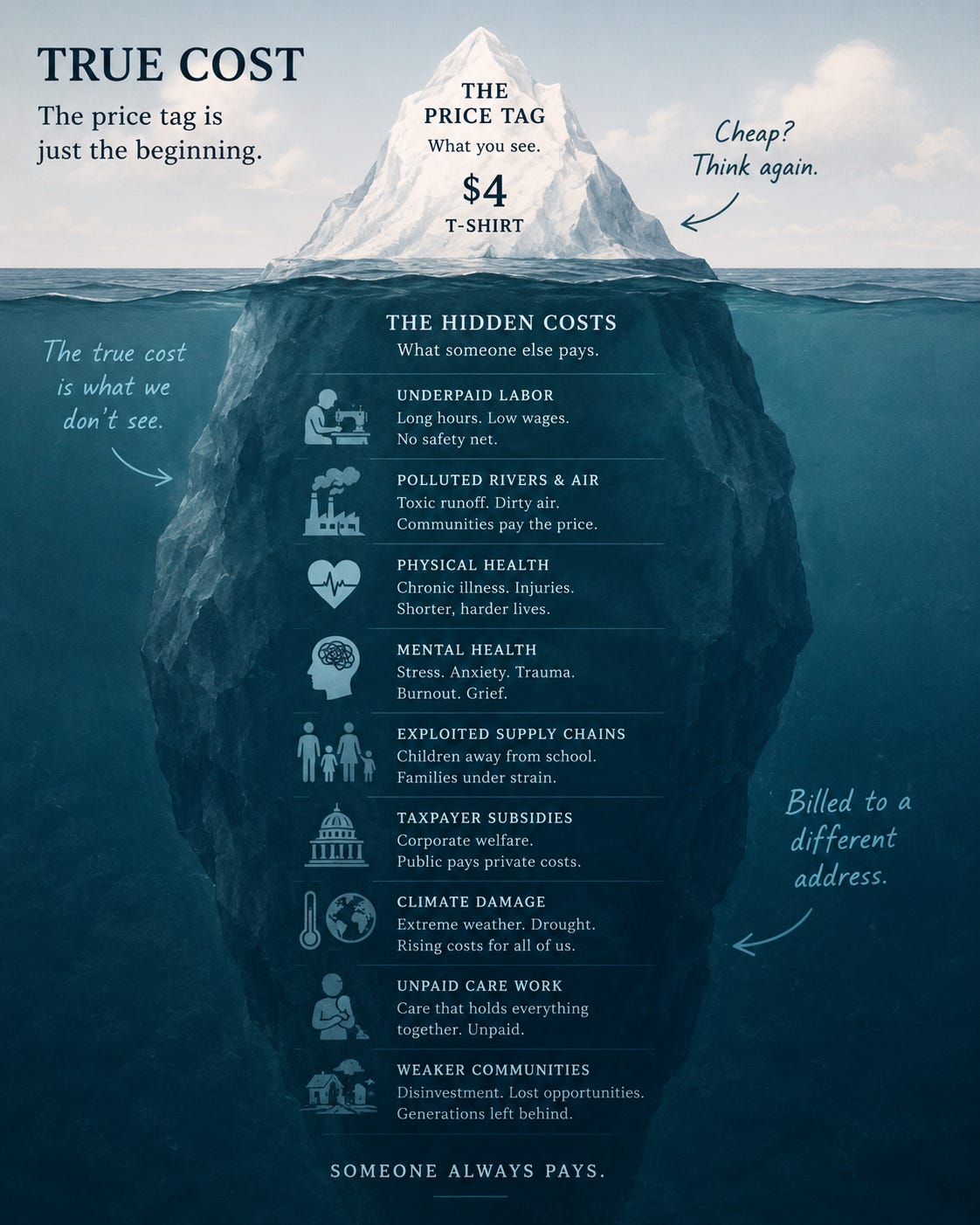
What is true cost? Here is the TL/DR: The price tag is not the true cost of something. The true cost is the price tag plus plus the hidden bill someone else pays. Economists call those someone-elses externalities, which is a tidy phrase that hides what is actually happening. The whole picture, sticker plus hidden bill, is the true cost of something.
For instance, a pound of coal in 1925 cost what it cost, and then it also cost the lungs of the miner who dug it, the streams the runoff poisoned, the kids who grew up without a father after the cave-in. The mine owner paid for none of that. The miner, the river, the family, the county hospital, and eventually the federal black lung program all paid instead. The coal looked cheap. It wasn’t. It was just billed to a different address. Coal powered enormous human progress and its costs were still hidden.
In my economics class, true cost showed up briefly as environmental damage: The commons getting polluted, the river getting poisoned. And we touched on how corporations that don’t pay a living wage are subsidized by government programs like Medicaid and SNAP. That part of the picture I did learn. The rest is what got me in trouble when I brought it up. What about the childcare cost? What about mental and physical healthcare costs for workers? What about the dignity cost of being told your paycheck is enough, just supplement with food stamps? None of that was on the syllabus, even though it is just as real, just as measurable, and just as much of a transfer of cost from the company that caused it to the bodies that absorb it.
True cost is enormous.
Hopefully you’re still with me, because I’ve been thinking about that class the past two weeks. Ever since two news stories collided in my head and they are, underneath, the same story.
The first: Fidelity told its 6,200 Boston employees they have to come back to the office five days a week starting in September. Massachusetts Governor Maura Healey praised the move, suggesting that more employees in the office could boost foot traffic for local businesses and contribute to the vibrancy of downtown. Fidelity called it a “thoughtful, gradual approach” centered on connection, mentorship, and learning. The readers of Boston.com, who actually have to commute, were less charmed. Sixty-nine percent opposed the move. Scott from Waltham hit the nail on the head: back-to-the-office mandates are about protecting the value of corporate real estate.
Scott’s right, but there’s more there. Fidelity is not actually paying the true cost of its decision. The employees are: They’re paying in gas (have you seen gas prices?), in parking, in childcare, in the second car the family suddenly needs again, in the two and three hours of daily commute that one reader from Salem said she now faces. The average US commute already costs somewhere between $5,750 and $8,466 a year, depending on whose math you trust; in New York or San Francisco it tops $11,000 to $12,650. In Boston, it’s not cheap.
Gov. Healey’s vibrancy argument is the kind of thing that sounds nice if you don’t run the numbers because a worker forking over an extra $500 a month for gas and parking to physically arrive at Fidelity does not have five hundred more dollars to spend on a downtown lunch. She has less. The money moves from her wallet to the oil company and the parking garage. Not to mention if she needs childcare or a new car! Meanwhile Fidelity’s real estate stays valuable. Downtown gets a thinner version of “vibrancy” than it had when those workers were spending freely closer to home.
And that’s just the cash cost. The mental health cost is the part my professor never wanted to discuss. A South Korean study of more than 23,000 workers found that people commuting more than an hour were 16 percent more likely to experience depressive symptoms, with the effect strongest among low-income workers, shift workers, and women with children. A Swedish longitudinal study found that women with long commutes had a mortality rate 54 percent higher than women with short ones. 54%!!! That’s not a side effect - that’s a body count. And it doesn’t appear on Fidelity’s balance sheet because we’ve all agreed to pretend it’s not there. Just like the miner’s lungs were not on the coal company’s balance sheet.
The second story is from Hangzhou, China, where a court ruled this spring that a tech company illegally fired a quality-assurance worker named Zhou after his job was automated by AI. Zhou’s job was verifying AI-generated answers. The company offered him a reassignment at a 40% pay cut. He refused, they fired him, he sued, and he won at every level. The court was explicit: AI integration is a strategic choice the company made and the cost of that choice cannot be shoved unilaterally onto the worker.
The court’s reasoning is the part I keep coming back to. The panel found that by citing AI as grounds for firing Zhou, the company had “effectively shifted the risks of technological iteration onto its employees.” Read that sentence again: The company had shifted the risks. Onto the employees! That is the language of true cost, spoken from a Chinese bench. The legal scholars commenting on the ruling went further. “The costs of technological transformation should not be borne solely by workers,” they wrote. AI, the court said, should “liberate labor and promote jobs,” not become a free pass for companies to externalize their transition costs onto households, communities, and the social safety net.
I’m not romanticizing China. I am noticing that somewhere on this planet, a court has just decided not to pretend a corporate decision was an irresistible force of nature. They named the cost. They named who was trying to skip the bill. And they named who would have ended up paying it if the company had gotten away with it: not just Zhou, but everyone downstream of Zhou losing his livelihood.
We do not do that here in the United States. We have not done it for a long time. And the clearest example is so familiar it has stopped feeling like an outrage, which is itself the problem. In 2014, Americans for Tax Fairness estimated that Walmart’s low-wage workforce cost U.S. taxpayers about $6.2 billion a year in food stamps, Medicaid, and subsidized housing. A 2020 Government Accountability Office report commissioned by Senator Bernie Sanders confirmed the pattern at scale: 5.7 million full-time workers were enrolled in Medicaid, and 4.7 million were on SNAP and Walmart was among the top four employers of SNAP and Medicaid recipients in every single state agency that reported data! McDonald’s was top five in thirteen of fifteen states. As of late 2025, around 51 percent of SNAP households included a working adult. The taxpayer, who is also the worker, who is also the customer, is paying Walmart’s payroll in three different directions. And Walmart calls itself efficient.
This is what externalities look like when you stop calling them externalities and call them what they are: cost-shifting. Walmart shifts payroll cost onto the federal budget. Fidelity shifts real estate cost onto the household budget. The unnamed Hangzhou tech company tried to shift the cost of automation onto Zhou. The coal company shifted the cost of black lung onto the miner and his family and, eventually, the rest of us. In each case the bill is real, the bill is being paid, and the only question is who pays it.
This is not a problem built into the very idea of trade or markets. It’s a problem built into the version of capitalism we in the US have been running for the last forty-plus years, the one that treats every cost it can externalize as someone else’s problem and calls the result efficiency. Other versions exist. For example, if you want to see what happens when a capitalist society insists on something a little closer to true cost, look at Denmark. McDonald’s workers in Denmark earn around twenty dollars an hour, get six weeks of paid vacation, and receive life insurance, maternity leave, a pension plan, and fully paid sick leave. Denmark doesn’t have a minimum wage law; the wages are set by sector-wide collective bargaining between unions and employer associations, and once signed, the agreement is the floor for the whole industry. The fast food worker is not subsidizing McDonald’s. McDonald’s is paying something much closer to what its labor actually costs. And the US business press cannot quite metabolize what happens next: The sky did not fall. McDonald’s still sells burgers. Denmark still exists, with its bicycles and its dental care and its astonishingly well-rested employees.
I’m not going to pretend Danish McDonald’s pays true cost. It does not. The factory-farmed cow is still factory-farmed. The carbon is still released. The plastic still ends up in the ocean. Denmark has moved one cost, labor, closer to honest accounting while leaving most of the others untouched. But that is the point! Even getting one externality right, even partially, even imperfectly, didn’t destroy the economy. It just made the workers’ lives better and the burger thirty cents more expensive.
So when I sit with these stories together (Fidelity, Hangzhou, Walmart, the coal companies, with Denmark as a partial counterexample), what I see is this: US corporations have been allowed, for forty-plus years, to call their cost-shifting “strategy.” Return-to-office is real-estate cost-shifting. Replacing workers with AI without retraining or compensation is technology cost-shifting. Walmart wages are payroll cost-shifting. Cheap eggs are health and environmental cost-shifting. The bill is real in every single case. And the bill is being paid. We’ve just been trained not to look at who is paying it.
And so I leave you with an invitation: the next time a company announces something and a politician calls it good for the community, ask the true-cost questions: Who is actually paying for this? Where does the money come from, and where does it go? What is hidden in the word “strategy”? What is hidden in the phrase “good for the economy”?
True-cost accounting is not a policy proposal. It’s a habit of seeing and once you can see it, you cannot unsee it.
We’ve been paying the bill the whole time. We just didn’t get a receipt.
Nice interesting perspective on this: https://www.theatlantic.com/ideas/2026/05/minimum-wage-experiment-worked/687255/?gift=mKOLV4Ib44pyiuMPL6ej0KME3GrpEO8g2ddABZdsWYo