
I Maybe Have Too Many Beans
Reflections at T-minus 14 days to #Vanlife

Two weeks.
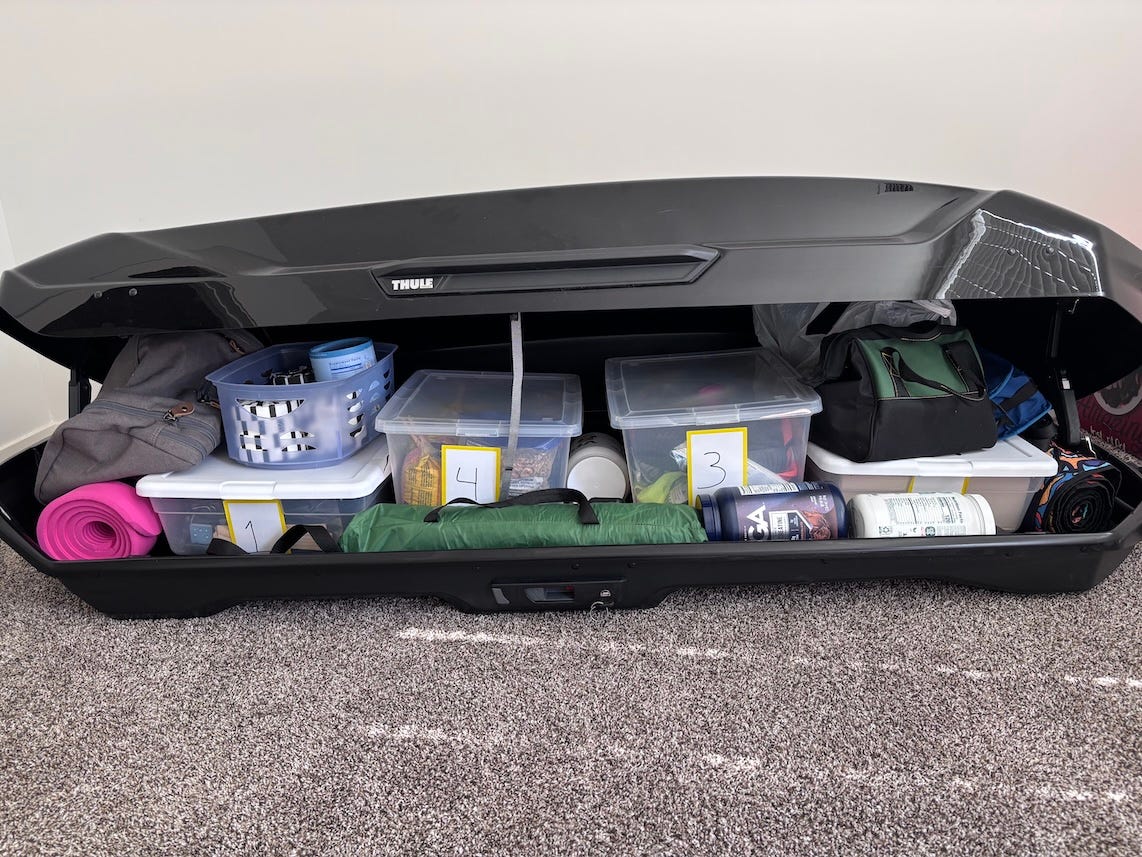
In two weeks I’ll be living in a converted Toyota Sienna minivan named Mystique. I have been planning this transition for nearly two years. I built the van. I researched the insurance. I joined the RV club. I picked the state in which to domicile. I have a cargo box for the roof, a suspension lift scheduled, internet across three carriers, and an evaporative cooling bag for my HRT patches so my hormones don’t cook in a parking lot in Tennessee.
I have, by all reasonable measures, prepared.
I’m also, two weeks out, remembering something I should have thought of already: you cannot fully prepare for a transition. You can prepare for the logistics, but the emotional part of a transition reveals what it reveals when it reveals it.
I should have remembered this earlier. I am, afterall, an expert on transitions. I have served congregations as both congregational life staff and as an interim minister, not to mention years of settled ministry before that. My entire job is to shepherd communities through change. I know the theory. I have taught the theory.
And here I am, two weeks out, undone by my beans.
Let me explain the beans.
I do meal prep. Dry beans are cheap and nutritious. Fiber and protein are a peri-menopausal woman’s best friend. And I have genuinely cut my grocery bill in half by buying multi-pound bags of lentils, red lentils, green split peas, soybeans, chick peas and black beans. I love my beans.
And … my beans are taking up approximately one third of the 95-pound weight limit in my rooftop cargo carrier, affectionately designated as Mystique’s “attic.”
I will make two more big batches of beans before I leave, which should get me down by maybe five pounds. The rest of the beans are coming with me. Apparently. Because despite weeks of trying to eat my way through them, the beans are winning.
This is a problem. It is also, I’m realizing, not really about the beans.
There are a lot of ways we can think about change and transitions — many models for looking at them. Today, I’m reflecting on four kinds of transitions in particular:
The first is going from something known to something similar. For example, moving from one house to another. The change is real but the shape is familiar. You adjust without much disorientation.
The second is going from something known to something you thought would be similar but turns out to be completely different. This one produces whiplash. The disorientation is sharper because you didn’t see it coming. Think about going from school in one state to another: It seems like they will be the same but the cultures, the methods and the materials all make it different than you thought it would be.
The third is going from something known to something genuinely new but well-mapped by others. Parenting is the classic example. Terrifying, life-altering, but there are books and grandmothers and pediatricians and a thousand years of accumulated cultural wisdom. You are not the first to walk this road, even if it is new for you.
The fourth is going from something known to genuinely uncharted territory. No map. No guides. You are making the path.
These aren’t hard and firm categories. They can, and often do, overlap and mix.
Vanlife, I’m already learning, is a weird hybrid of the third and fourth kinds: There ARE people who have done this. There are blogs and YouTube channels and Facebook groups and (this surprised me) a substantial population of women in their 50s and 60s who have chosen this exact thing. In some ways, I am almost a cliché.
But the map is thin. There aren’t books on every shelf. There aren’t grandmothers to call to see how they did it. There is no expert for “how do I keep my HRT patches at room temperature in a hot van,” so I had to figure that out myself, with a cooling bag and wireless thermometers I can monitor from my phone. And there’s no cultural script for “I’m a 55-year-old minister leaving a building and a city and moving into a vehicle so I can drive around the continent because I’m tired of living by the rules of capitalism and patriarchy and white supremacy culture.”
The map is real, but partial. Which means I keep being surprised by what is hard, by what is easy. And by what I’m grieving and what I am not.
What has been easy:
Getting rid of furniture. I thought this would be difficult. Nope. I sold things, gave things away, put a few things in storage. It felt almost entirely liberating. When I eventually settle somewhere again I will be ready for an entirely different kind of life, with different furniture to match it.
Leaving my work. I had three years at the UU Church of Indianapolis. My last Sunday was two days ago. It was full of love and gratitude and tears and the particular quality of goodbye that comes when the work has been done well. It was healthy. I’m proud of the ending we made together.
Saying goodbye to the Circle City Skate Crew, the skate club Andy and I started here. Our last skate was a beautiful 10-mile ride followed by ice cream. Full hearts. Full bellies. Real love. A clean ending that also really isn’t an ending because I can, and will, hit them up for a skate whenever I drive through Indianapolis.
What has been hard:
The beans and the weight limit in the attic. Because I also have supplies I might need. Tools I might need. Equipment I might need.
The spices. I had 60 of them. I now have 15. Each one was, literally, a small negotiation about what kind of cook I’m going to be in this next chapter and whether I trust that future self to find smoked paprika when/if she needs it.
The fact that I put down so many roots in Indianapolis when I told myself I was just passing through. The friends I made. The places that became mine. The way that even an interim ministry, which is by definition temporary, can grow into something that has weight when you go to leave it.
These are the things transitions reveal. Not what I planned for, but what was actually growing underneath.
Which brings me back to the beans.
I’ve always kept backups of everything. Shampoo, toilet paper. Charging cords. When my kids were growing up, their favorite cereal was always on the shelf. Always. Because that is how I love people: By making sure they never want for anything. When we move to the spare item, I buy a new one before we need it. This is how I have operated for all of my adult life.
I used to think this was just a personality trait. Anxiety, maybe. Or some kind of inherited frugality or organization skills. But I think now it has its roots elsewhere. In the car culture of the United States, most people don’t have a grocery store within easy walking distance. Grocery shopping becomes a weekly expedition. If you run out of shampoo on Tuesday and you don’t shop again until Saturday, that’s a problem. If your kid’s favorite cereal runs out on a Monday morning before school, that’s a problem. So you keep backups. The system requires it.
I didn’t realize this was a system, rather than just how life worked, until I saw something different. When my sister was in the Peace Corps in the Dominican Republic, I went to visit her. I learned that people in much of the world don’t grocery shop weekly: They stop on the way home and buy what they need for dinner. This blew my mind. The culture I grew up in and had adapted to was a response to a system. A reasonable response, even, given the constraints of the system. But in other parts of the world, people have made different choices about how to design their living areas and structure their daily lives.
The transition I’m making is not just from a house to a van. It’s from one whole way of organizing daily life to another. From stockpiles to provisioning. From “always have a spare” to “trust that you will find what you need when/if you need it.” That second one is, frankly, also a theology. It’s one I’ve been preaching for years. It is one I’m now being asked to actually live.
Here I am two weeks out, and I’m constantly singing The Way Knows the Way, reminding myself of that theology, which, not surprisingly, turns out to be harder to practice than to preach.
So here is what I’m thinking about right now: The transitions we plan for are not the transitions we end up making. The logistics are real and they matter — getting the suspension lift done, scheduling the doctors, figuring out the HRT — but the logistics are not the transition. The transition is the part you cannot prepare for, the part that shows up when you are sorting through your spice cabinet and realize you have feelings about 15 year old cardamom you didn’t remember you had bought that one time you made your own mango lassi years ago.
What surprises me is what is easy and what’s hard. What surprises me is not that I am grieving, but what I am grieving. What surprises me is how much of who I have been is structural — built in response to systems I didn’t consciously choose, but adapted to anyway, because adaptation is what humans do.
Two weeks out, I’m learning that I’m not just packing a van: I’m unpacking myself. And I’m finding that some of what I thought was essential turns out to be optional, and some of what I thought was incidental turns out to be the thing that matters most.
I’ll let you know what else gets revealed. I suspect there’s going to be a lot.
Meanwhile, the beans are going to go in the attic. For now.
Vanlife begins July 1. I will be writing from the road.
If you want more of this type of reflection stuff, my book Hard Hits & Other Life Lessons from Roller Derby is coming out this fall. It is, among other things, about what derby taught me about things from the power of community to microaggressions to the importance of touch. More details soon.
Transitions are strange things, full of expectations and "knowing" what the transition is going to be, only to find out that they're full of surprises. I'm hoping the positives and the negatives balance out nicely in your favor, while being confident that your ability to keep on rolling with ensure that good balance.
I believe root river rollers are looking for people….if your path happens to bring you near……..